
mars 2026
The escalation of the war in Iran is not just an energy story. It is also a farm-input story. While much of the international focus remains on the immediate fluctuations in oil and gas prices following the escalation of the conflict in Iran, the shockwaves are moving into the chemical building blocks of modern farming.
The chokepoint: Why Hormuz dictates global yields
Geographically, the strait of Hormuz is irreplaceable. According to the U.S. Energy Information Administration (EIA), roughly 20 million barrels of oil per day—about 20% of global consumption—transit this point. More critically for farmers, 20% of the world’s Liquefied Natural Gas (LNG) trade, primarily from Qatar, moves through these waters.
The thing is that natural gas is the primary feedstock for ammonia, the precursor to almost all synthetic nitrogen fertilizers. When the strait of Hormuz is disrupted, gas prices spike, insurance premiums for cargo ships skyrocket, and the energy-intensive process of fertilizer manufacturing becomes prohibitively expensive.
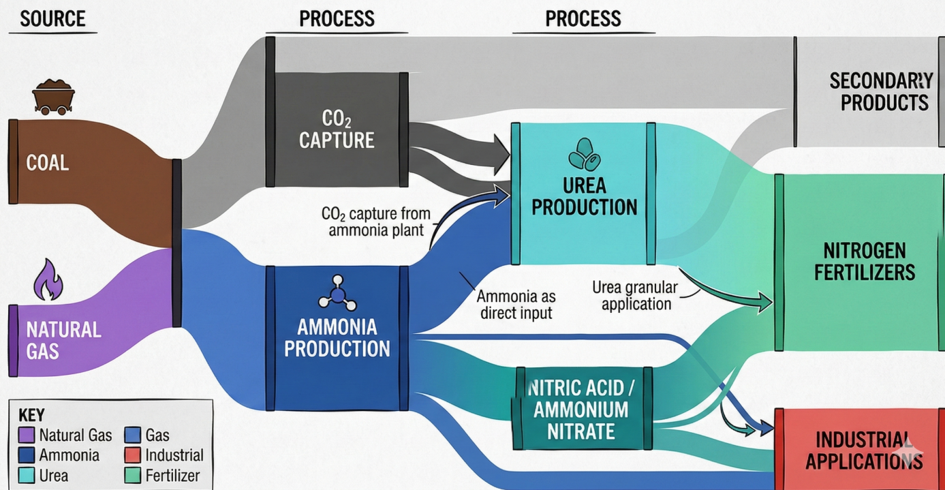
Simplified Sankey diagram explaining the relationship between feedstock and nitrogen fertilisers
The Market instantaneous reaction
The market response has been swift and severe. Data from the International Food Policy Research Institute (IFPRI) indicates that shipping through the Strait has plummeted by over 70% since the conflict’s onset. This disruption affects a corridor responsible for 20% to 30% of global fertilizer exports, including urea, ammonia, and phosphates. The impact on pricing was immediate:
- Urea (Middle East): Surpassed $590/metric ton in early March 2026, a 19% increase in just seven days.
- Urea (U.S. Gulf): Prices at the New Orleans hub jumped from $516 to $683/metric ton within days.
- Energy Costs: Crude prices for May 2026 delivery rose by 15% ($10 per barrel) in the same window.
The “Ukraine analogy”: Lessons from 2022
The closest historical benchmark for this crisis is the 2022 invasion of Ukraine. According to the World Bank, fertilizer prices surged 80% in 2021 and hit an all-time nominal high in early 2022. The drivers then—high gas costs, sanctions, and transport blockages—mirror the current situation in the Middle East.
The main lesson from 2022 is that price spikes often overshoot fundamentals and remain “sticky.” Even as trade routes were eventually rerouted, IFPRI noted that by 2025, urea prices remained 50% above 2020 levels. The current Iran shock is therefore hitting a system that was already fragile from previous Black Sea disruptions and Chinese export restrictions.
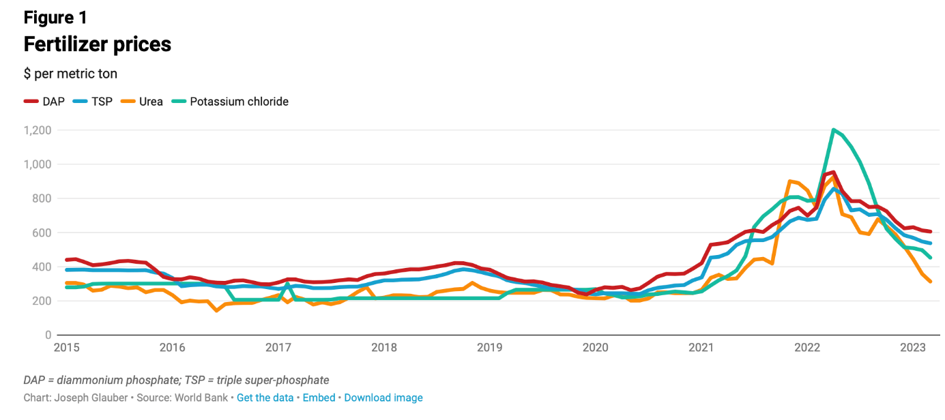
Source IFPRI
The second wave: Why pesticides are the next frontier
While fertilizers react immediately due to their direct link to natural gas, pesticides and plant protection products represent a “second-round” channel of inflation. Pesticides are different. Their cost structure is less directly tied to gas than nitrogen fertilizers, so the pass-through is usually slower and less explosive. But they are still part of the broader chemical economy, which depends heavily on oil and gas feedstocks. That means a prolonged Iran shock can still raise pesticide costs through petrochemical inputs, manufacturing energy, freight, and insurance:
- Feedstock Exposure: Pesticides rely on petrochemical inputs derived from oil and gas.
- Lagged Inflation: Historically, pesticide prices react slower than fertilizers but stay elevated longer. European Commission (Eurostat) data showed that in Q1 2023, pesticide prices rose 12% even as fertilizer prices began to ease.
- Logistics & Manufacturing: Prolonged energy shocks raise the cost of manufacturing and the freight required to move finished chemical products globally.
Looking ahead: The risks for 2026 and beyond
If the disruption in the strait of Hormuz persists for several weeks, the agricultural industry should expect:
- Localized shortages: Countries with high import dependence and tight planting calendars will be the first to suffer.
- Reduced yields: High input costs often lead to lower application rates, which directly impacts global crop yields and food inflation.
- Margin compression: Farmers already facing weak crop prices will see their margins squeezed, potentially leading to crop switching or reduced acreage.
The current Iran shock has not yet matched the scale of 2022. But the early signals — Hormuz disruption, higher oil and gas prices, and an abrupt jump in urea — are exactly the kind of signals that policymakers, agribusinesses, and farmers should take seriously.
A structural vulnerability of modern agriculture
These repeated crises reveal a deeper issue. Modern agriculture remains structurally dependent on fossil-fuel-based inputs, particularly nitrogen fertilizers. Because ammonia production depends so heavily on natural gas, the agricultural system remains highly sensitive to energy price volatility, geopolitical tensions and disruptions in maritime trade routes.
As long as this structural dependence persists, energy shocks will continue to translate rapidly into agricultural cost shocks — and potentially into food price volatility.
This growing exposure highlights once again the urgent need to make farming systems more resilient.
A key pathway is to reduce dependence on external inputs by strengthening ecological processes within the farm itself. In practice, this means building greater autonomy through circularity — recycling nutrients, energy and biomass within the farm — and by harnessing the productive capacities of living ecosystems.
In practice, this means mobilizing several “levers of nature”:
- Biological nitrogen fixation, through legumes such as clover, alfalfa, or fava beans, which can partially replace synthetic nitrogen fertilizers.
- Diverse crop rotations and crop associations, which improve soil fertility, break pest cycles, and stabilize yields.
- Polyculture–livestock integration, allowing nutrients to be recycled locally through manure rather than imported as synthetic fertilizers.
- Cover crops and permanent soil cover, which increase soil organic matter, improve water retention, and enhance nutrient cycling.
- Agroforestry and functional biodiversity, which can contribute to pest regulation, microclimate regulation, and long-term soil health.
These approaches do not necessarily mean producing less. Rather, they aim to intensify ecological functions instead of chemical inputs, shifting the source of productivity from fossil energy toward biological processes and agronomic knowledge.
In a world increasingly shaped by climate shocks, geopolitical instability, and volatile energy markets, resilience will increasingly depend on the capacity of farming systems to rely less on global input markets and more on the regenerative capacities of their own ecosystems.