
9 février 2026
In recent weeks, Morocco has been hit by major, sometimes violent floods in agricultural areas that had just emerged from nearly seven years of drought.
Morocco is not an isolated case: similar sequences of prolonged droughts followed by extreme rainfall have recently been observed in East Africa (Somalia, Kenya, Ethiopia in 2023), the Sahel (floods in 2020), Zimbabwe (2016–2017) and southern China in 2024. These events are one of the most visible symptoms of climate change, but also of an often underestimated issue: the health of agricultural soils.
Why does farmland flood after a long drought?
Why soils that have been dry for years become suddenly unable to absorb water, causing flash floods and considerable damage?
The answer lies in the gradual degradation of our agricultural land. After long periods of drought, soils often become more vulnerable. A lack of organic matter, absence of vegetation cover and intensive farming practices can lead to:
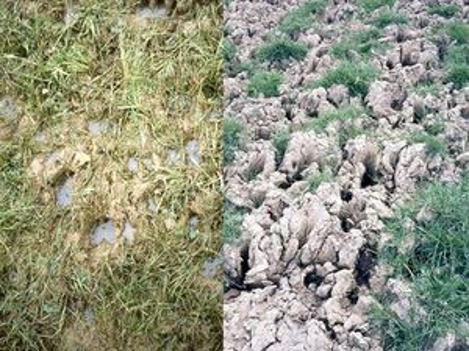
- Soil compaction: Under the effect of trampling by livestock, repeated passage of heavy agricultural machinery, or simply the absence of a dense root structure, the soil loses its porosity. Aggregates break down, fine particles accumulate, and water infiltration capacity decreases dramatically.
- Loss of organic matter: Organic matter acts like a giant sponge in the soil. It retains water, promotes the formation of stable aggregates and nourishes microbial life. During prolonged drought, the decomposition of organic matter accelerates, and if it is not renewed, the soil loses its absorption and retention capacity.
- Surface crust formation: When heavy rain falls on bare, unstructured soil, the impact of the raindrops can break up the surface particles, creating a thin impermeable layer that prevents water from penetrating.
The result: when heavy rain falls, the water no longer infiltrates properly. The soil acts like a hard surface: water runs off, accumulates, and causes rapid flooding, even in agricultural areas far from watercourses.
Living soil can infiltrate several tens of millimetres of water per hour. Degraded soil… sometimes less than 5 mm.
What are the consequences for crops?
The impacts can be numerous and often severe:
- Root asphyxia: excess water drives oxygen out of the soil, preventing the roots from breathing.
- Physiological stress and stunted growth.
- Increased diseases (fungi, root rot).
- Yield losses, or even total destruction of plots
- Erosion and irreversible loss of fertile soil
These effects are all the more pronounced when crops are already weakened by past drought.
How can we prevent this from happening again?
The key is not just to ‘manage water’, but to rebuild soils that can absorb, store and release it. Healthy soil acts like a living sponge: it limits flooding during periods of extreme rainfall and supports crops during periods of drought.
To prevent such scenarios from recurring, it is imperative to adopt agricultural and land use practices that promote soil health and better water management. Here are a few option:
Enriching soils with organic matter
- Organic amendments (compost, manure, organic residues): Regular applications of compost, manure, or other organic inputs increase soil organic matter, improve aggregate stability, and enhance the soil’s capacity to retain and slowly release water.
- Cover crops and green manures: Establishing cover crops between two main cropping cycles protects the soil from erosion, feeds soil biology, and produces biomass that enriches the soil while improving its structure and porosity.
- No-till or reduced tillage: Reducing or eliminating tillage helps preserve soil structure, maintain organic matter near the surface, and protect the network of pores and channels created by roots and soil fauna, which are essential for water infiltration and aeration.
Covering the soil permanently:
- Mulching: Mulching crops limits evaporation, protects the soil from direct rainfall and reduces runoff.
- Agroforestry: Integrating trees and shrubs into agricultural systems provides permanent vegetation cover, improves biodiversity and structures the soil in depth thanks to their roots.
Landscaping for better infiltration:
- Terraces and grass strips: In sloped areas, creating terraces or grass strips perpendicular to the slope slows runoff and promotes infiltration.
- Hedges and copses: These features act as windbreaks and slow down runoff, while increasing biodiversity.
- Infiltration ditches and ponds: Create structures to capture rainwater and allow it to slowly infiltrate the soil.
Promoting sustainable agricultural practices:
- Crop rotation: Alternating crops allows for varied root systems, improves soil structure and limits nutrient depletion.
- Integrated water management: Adopt efficient irrigation techniques (drip irrigation) and ensure that soils can maximise rainwater absorption through regenerative hydrology practices.
Healthy soil acts like a living sponge: it limits flooding during periods of extreme rainfall and supports crops during periods of drought.
The key role of root systems in cover crops
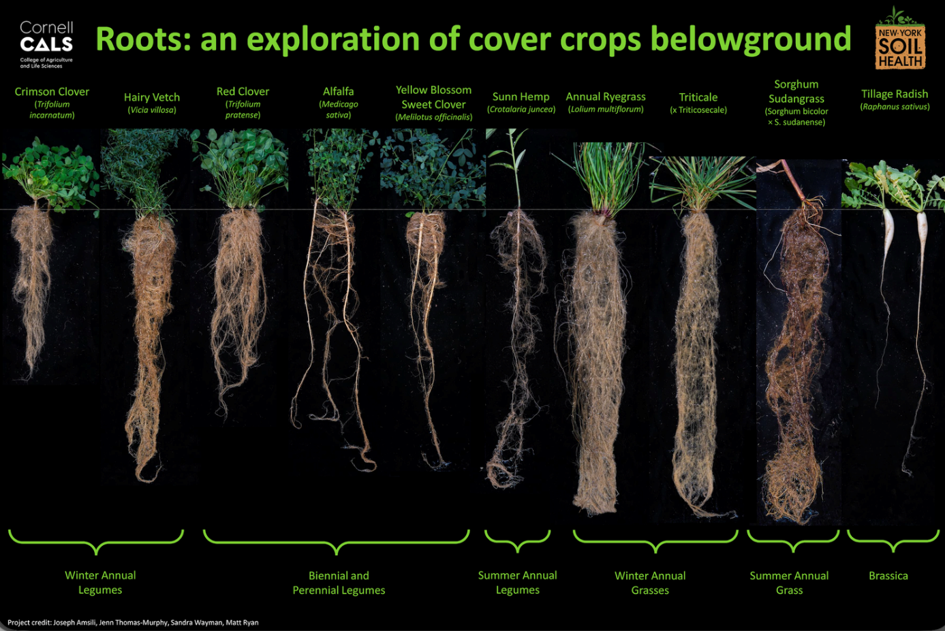
Cover crops play a central role in restoring soil structure, mainly thanks to the diversity and architecture of their root systems. Unlike bare soil, where pores quickly close under the effect of rain or drought, covered soil is constantly traversed by living roots, which create and maintain pathways for water infiltration.
Certain species are particularly effective at loosening and structuring the soil at depth:
- Fodder radishes and turnips (powerful taproots) penetrate compacted soil layers and create vertical macropores, facilitating water infiltration during heavy rainfall.
- Legumes such as field beans, vetch and clover develop a dense, branched root network that stabilises soil aggregates while stimulating biological activity.
- Grasses (rye, oats, forage sorghum) form a fine network of shallow roots, which is very effective in improving surface porosity, limiting runoff and protecting the soil from erosion.
As they decompose, these roots leave behind permanent tunnels, which are reused by water, air, the roots of subsequent crops and soil fauna (especially earthworms). They also feed microorganisms via root exudates, reinforcing the structural stability of the soil.
The result is better structured, more porous and biologically active soil that can quickly absorb heavy rainfall, reduce flooding on the plot and store water for dry periods. Cover crops are therefore not only surface protection, but a real tool for biological soil engineering, essential for coping with increasing climate variability.
Robustness over performance: a shift in paradigm
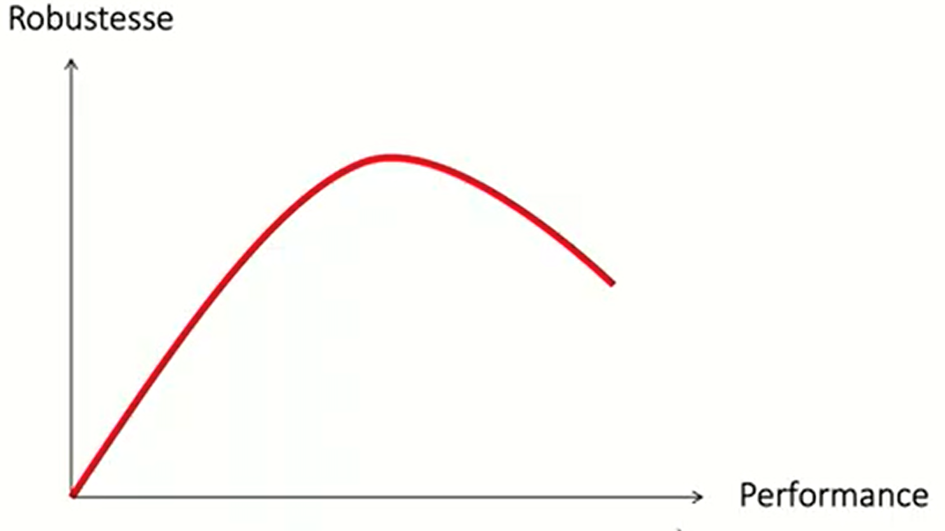
As biologist Olivier Hamant points out, our systems – both agricultural and economic – have been designed to maximise performance under stable conditions, at the expense of their resilience to shocks. In agriculture, this translates into soils that are optimised for short-term yield but unable to absorb extreme stresses such as prolonged droughts or heavy rains.
Soil health perfectly illustrates this principle: living soil is not necessarily the most productive every year, but it is resilient, able to withstand hazards, buffer water, protect crops and maintain production in uncertain conditions. In this era of climate change, rebuilding resilient agricultural systems is no longer an option, it is a necessity.
The recent floods are not only a climate disaster. They are also a clear agronomic warning: without living, resilient, and functional soils, agricultural systems cannot effectively absorb either drought or excess water.
Investing in soil health means investing in:
- resilience to climate shocks
- long-term food security
- the sustainability of farms and agricultural landscapes
This is a long-term effort, but it is essential.
We will continue to share analyses, tools, and field-based insights to support this transition, alongside farmers and all stakeholders working on the ground.
Join us and stay informed to accelerate the agroecological transition