
29 avril 2026
The latest update from the World Meteorological Organization confirms a rapid shift in the Pacific Ocean, with a high likelihood that El Niño conditions will develop between May and July 2026.
Sea surface temperatures in the equatorial Pacific are rising quickly, and climate models are now largely aligned: El Niño conditions are now the baseline expectations for the second half of 2026.
While El Niño is a natural cycle, its return this year is far from “business as usual.” It arrives at a moment of unprecedented convergence between climatic instability and geopolitical volatility
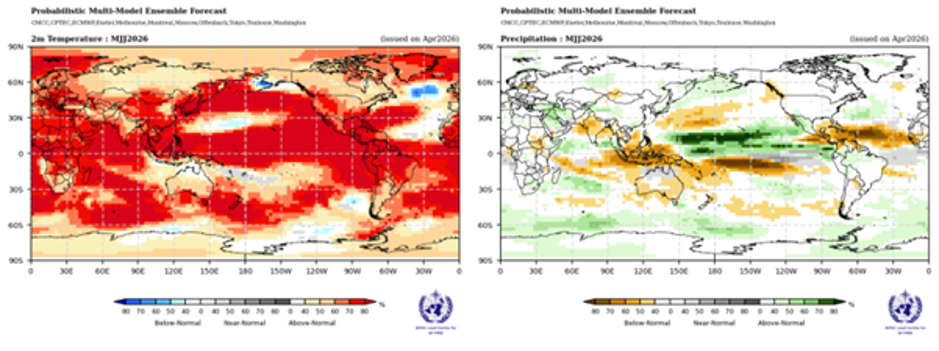
Probabilistic forecasts of surface air temperature and precipitation for the season May-July 2026. Source WMO
The climate mechanics: heat and asymmetry
For the 2026–2027 growing season, the WMO projects a “global dominance” of above-normal land temperatures. For producers, this isn’t just about warmer days; it’s about a fundamental shift in how crops and livestock function.
Heat is becoming a structural baseline. Elevated temperatures do more than stress crops: they accelerate phenological cycles, often shortening grain-filling periods and ultimately reducing yields. Livestock systems are equally affected, as rising thermal stress directly impacts feed intake, fertility, and overall productivity.
At the same time, rainfall patterns are becoming increasingly polarized. Under El Niño conditions, water is effectively redistributed across the globe: regions such as the southern United States and the Horn of Africa face heightened risks of excess rainfall, waterlogging, and soil erosion, while Australia and Southeast Asia are likely to experience significant soil moisture deficits and heightened drought pressure.
This combination of heat and hydrological imbalance is already pushing food systems toward critical thresholds. A recent joint report by the Food and Agriculture Organization and the World Meteorological Organization warns that increasingly frequent and intense heatwaves—both on land and at sea—are bringing food supply systems in some regions “to the brink.”
The geopolitical multiplier: the shadow of the Iran war
These climate dynamics cannot be assessed in isolation. The current conflict involving Iran is reshaping the underlying conditions of global agriculture, effectively weakening the system’s ability to absorb additional shocks.
First, the issue of energy and input costs. Agriculture fundamentally operates as a transformation of energy into food, through fertilizers, mechanization, irrigation, and transport. Disruptions across the Persian Gulf, combined with heightened volatility in energy markets, are already pushing up the cost of key inputs such as nitrogen-based fertilizers and diesel. In this context, an El Niño–driven production shock does not occur in a stable environment. It collides with a cost structure that is already under severe pressure.
Second, trade and logistics are becoming more fragile. Instability in the Middle East affects critical transit corridors that connect major grain-producing and importing regions. Should El Niño impact production in key exporters like Southeast Asia or Australia, the usual rebalancing mechanisms of global trade (e.g. rerouting supply, scaling imports) become slower, more expensive, and less reliable.
The result is a growing compound fragility. Regions already exposed to the economic ripple effects of geopolitical tensions, particularly across North Africa and the Levant, are also among the most vulnerable to El Niño–induced rainfall variability. What emerges is not a sequence of isolated shocks, but a true polycrisis, where climate disruptions and war-driven inflation reinforce each other, amplifying systemic risk across food systems.
From anticipation to resilience: aligning climate intelligence with biological design
El Niño’s predictability is its only real advantage: it gives us a lead time of several months to act. But in the context of 2026–2027, anticipation cannot rely solely on forecasts or tactical adjustments. It must be coupled with a deeper redesign of farming systems; one that integrates climate intelligence, financial safeguards, and agroecological resilience.
At the operational level, several levers can be activated immediately. Crop strategy is the first line of defense: shifting toward heat and drought tolerant varieties is no longer a marginal optimization, but a structural hedge against rising baseline temperatures. At the same time, water management must become dynamic and context specific. In drought prone areas, this means optimizing irrigation scheduling and prioritizing water efficiency; in flood exposed regions, the focus shifts toward drainage, soil structure, and preventing nutrient leaching. Beyond the field, financial instruments such as weather-index insurance and flexible credit lines are becoming essential to absorb increasing climate and market volatility.
However, these measures alone remain insufficient if the underlying system is fragile. The most robust response to the 2026 climate outlook lies in strengthening the biological foundations of the farm itself. Agroecology offers a framework to move from reactive correction to systems that can absorb shocks and maintain function under stress.
Soil is the central pillar of this resilience. Managed properly, it acts as a buffer against both drought and excess rainfall. Increasing soil organic matter, even marginally, can significantly enhance water retention, while practices such as mulching, cover cropping, and reduced tillage help regulate soil temperature, limit evaporation, and preserve structure. In a year marked by hydrological extremes, soil effectively becomes a natural water storage and regulation system. Structural diversification further reinforces this resilience. Integrating trees through agroforestry systems creates localized microclimates that reduce heat stress on crops and livestock, while also limiting wind-driven evapotranspiration. These systems introduce vertical complexity that monocultures lack, stabilizing production under variable conditions.
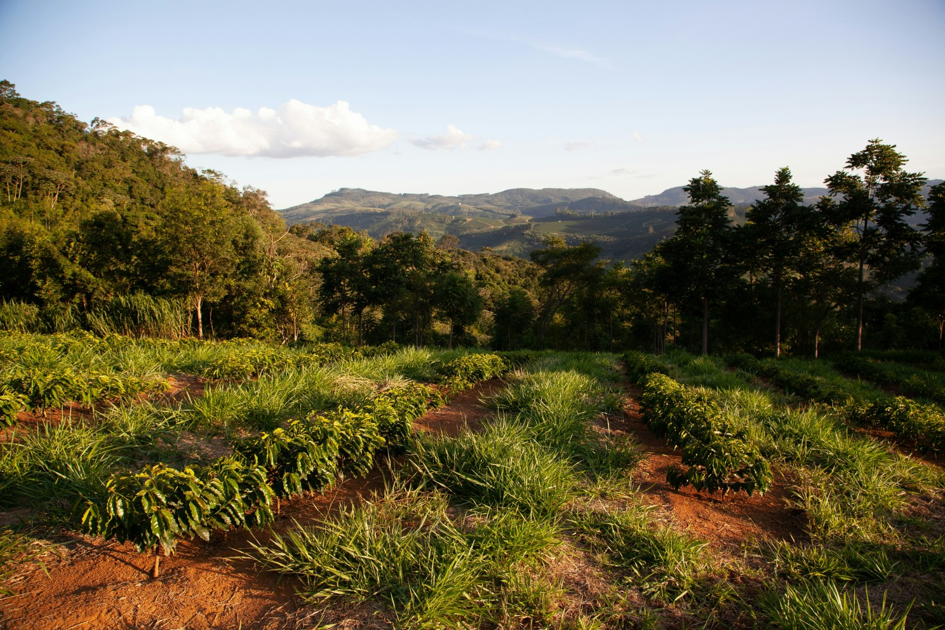
Photo by PROJETO CAFE GATO-MOURISCO on Unsplash
Finally, diversity at the crop and genetic level reduces systemic vulnerability. Polycultures and intercropping strategies distribute risk across species with different sensitivities to heat, water stress, and pests. Similarly, traditional or locally adapted seed varieties, often overlooked in high-input systems, can offer critical tolerance traits that become decisive under El Niño conditions.
Taken together, these approaches mark a shift from short-term adaptation to structural resilience. In a context where climate variability is intensifying and interacting with broader geopolitical and market disruptions, the farms that will endure are not those that react fastest, but those that are designed to withstand uncertainty by construction.
Rethinking resilience in a non-linear world
The 2026 El Niño should not be understood as an isolated climatic episode, but as part of a broader reconfiguration of risk. What is unfolding is the convergence of multiple systemic forces (oceanic variability, structural warming, and geopolitical instability), interacting in ways that make past reference points increasingly unreliable.
The farms and food systems that will navigate the coming season most effectively are not necessarily those with the most resources, but those able to align decisions with emerging dynamics, adjusting practices, reallocating risks, and redesigning systems ahead of disruption rather than in response to it.
The months ahead will not simply test production systems; they will test our collective ability to move from reaction to anticipation and adaptation in a world where uncertainty is no longer the exception, but the operating environment.