23 August 2026
Local ownership: co-designing durable transitions
A practice can look relevant on paper and fail in the field. It may require too much labour, depend on unavailable equipment, create economic risk or conflict with the rules of a supply chain. This does not necessarily mean the practice is useless. It shows that a transition cannot be transferred as a finished object: it must be adapted and owned locally.
Start from lived realities
A useful diagnosis goes beyond a database. It reveals existing practices, room for manoeuvre, perceived risks, relationships between actors and each group’s priorities. Field visits, interviews, workshops and observation of work calendars complement agronomic, climatic and economic data.
This listening often reveals solutions that already exist. A forgotten technique, a mutual-aid arrangement or a locally adapted variety may offer a stronger starting point than an innovation imported without adaptation. Support is then as much about connecting and strengthening what exists as introducing something new.
Farmer varieties and local seed systems
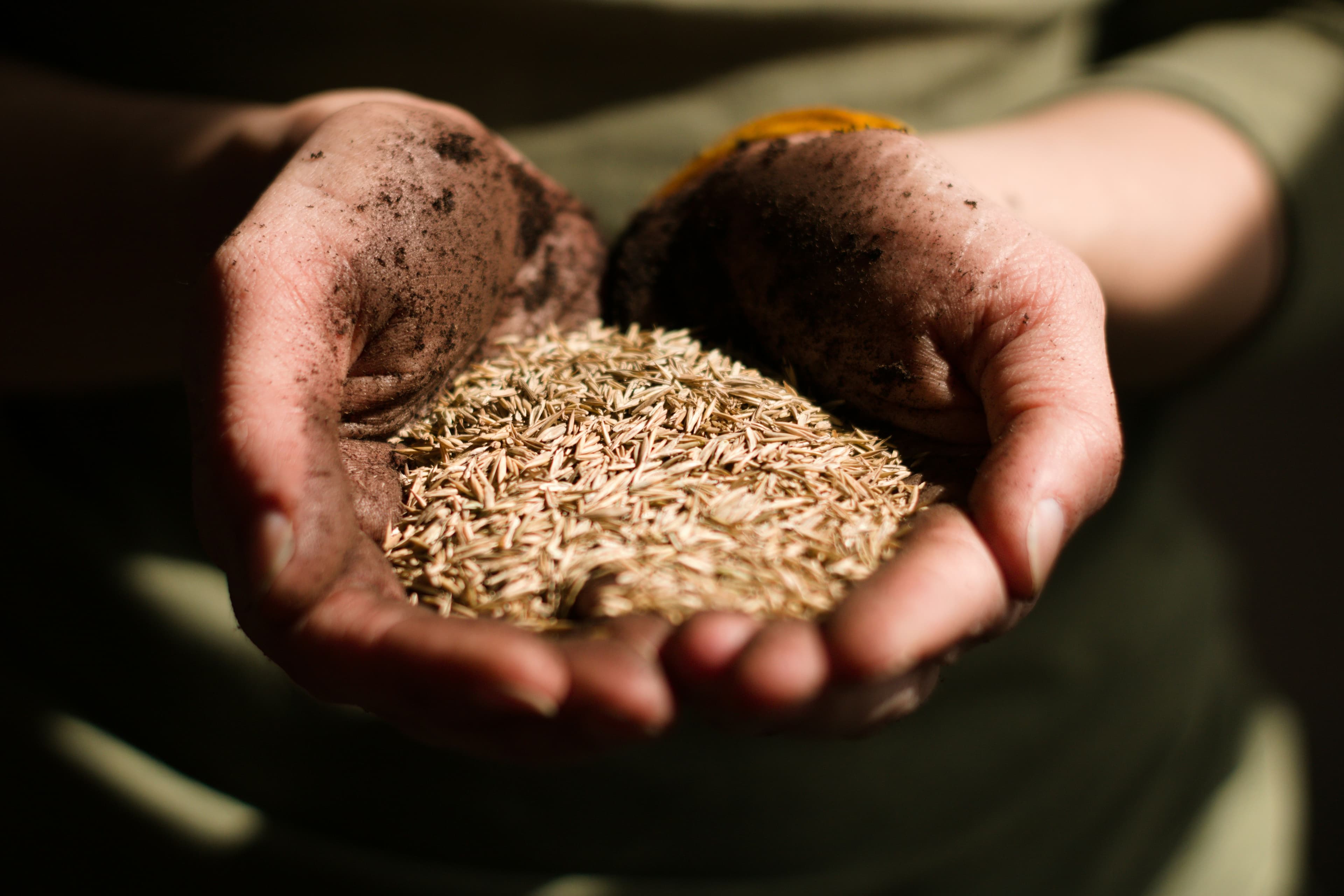
Farmer-managed seeds illustrate the importance of local ownership. Selected, conserved and exchanged by farmers over generations, they carry knowledge of local soils, growing conditions and food uses. They are not only a heritage to preserve: they can contribute to maintaining a diversity of responses as climate and farming practices change.
Their value depends on how they are supported. A seed adapted to one territory will not necessarily perform everywhere, and its qualities may vary from year to year. Farmer networks, seed houses, associations, researchers and producer organisations can document knowledge, organise exchanges and create spaces for experimentation. This cooperation combines local experience with useful methods for characterisation and monitoring.
Working with farmer-managed seeds also raises questions of organisation and rights. Conservation, multiplication, access to genetic resources and marketing must respect the relevant framework while protecting community knowledge and capacity to act. Local projects should involve farmers from the start and clarify how collectively developed resources are governed.
Co-design rather than prescribe
Co-design makes farmers and local actors partners in decision-making. Several scenarios can be compared, trade-offs discussed, pilot plots selected and success criteria defined together. This makes choices visible: labour today against expected benefit, immediate investment against future resilience, individual interest against a collective service.
A co-designed project is not necessarily slower. By addressing objections and constraints early, it reduces the risk of blockage during implementation. It also identifies people who can share the practice, host a trial or contribute to evaluation.
Organise collective learning
Transitions move through cycles of testing, observing, discussing, adjusting and sharing. Pilot plots, peer groups, demonstrations and field feedback create practical opportunities to learn. Difficulties and failures should also be documented because they prevent others from repeating unsuitable choices.
Data can support this learning without replacing it. Simple indicators chosen with users make progress visible. A useful measure is one that supports a decision: change a rotation, adjust a cover crop, move a hedge, revise a calendar or alter a collective arrangement.
Create the conditions for adoption
Adoption depends on access to skills, equipment, finance, markets, recognition and the ability to absorb risk. A training session is not enough if farmers cannot put the learning into practice. Advice, experimentation, logistics and follow-up need to be connected.
Local institutions and supply chains have an important role. They can facilitate access to water, research, seeds, shared equipment or finance. They can also create rules and incentives consistent with regeneration, instead of asking individual farms to carry the whole cost of change.
Think of the territory as a system
Agroecological effects rarely stop at a field boundary. Water quality, hedgerow continuity, animal movement, market access and labour availability depend on territorial relationships. A local action becomes stronger when it connects with other initiatives and with governance capable of coordinating interests.
Local ownership does not mean isolation. Territories also learn from one another. Sharing experiences, data and methods avoids starting from scratch, provided each lesson is translated into the new context rather than copied mechanically.
Make progress visible
Local action needs concrete signs of progress: less time spent on an operation, better tree survival, lower runoff or adoption by new farmers. Indicators should remain understandable and discussed with the people who use them. Their purpose is to support learning, not turn the project into an administrative exercise.
A durable transition is one that local actors can understand, adapt and continue to carry when the initial project ends. By giving a central place to people, knowledge and institutions in the territory, local ownership turns a promising practice into a lasting collective capacity to act.